Specialist Research Process — End-to-End
When a clinician (or another agent) poses a clinical question to AiMOneHealth, the answer is not a single LLM call — it's a structured pipeline that retrieves, reasons, adversarially re-checks, and records every step. This page walks through the full flow as an interactive stepper, then lays out the decision points with balanced pros/cons so a reviewer can judge whether the production defaults are right for their setting.
Controls — ◀ / ▶ buttons step manually · ▶ Play autoplays (default 3.5s/frame; pick from the Speed menu, slowest is 6s) · click any dot to jump · keyboard
←/→/Spacewhen the panel has focus.
Walkthrough — the full pipeline, agent by agent
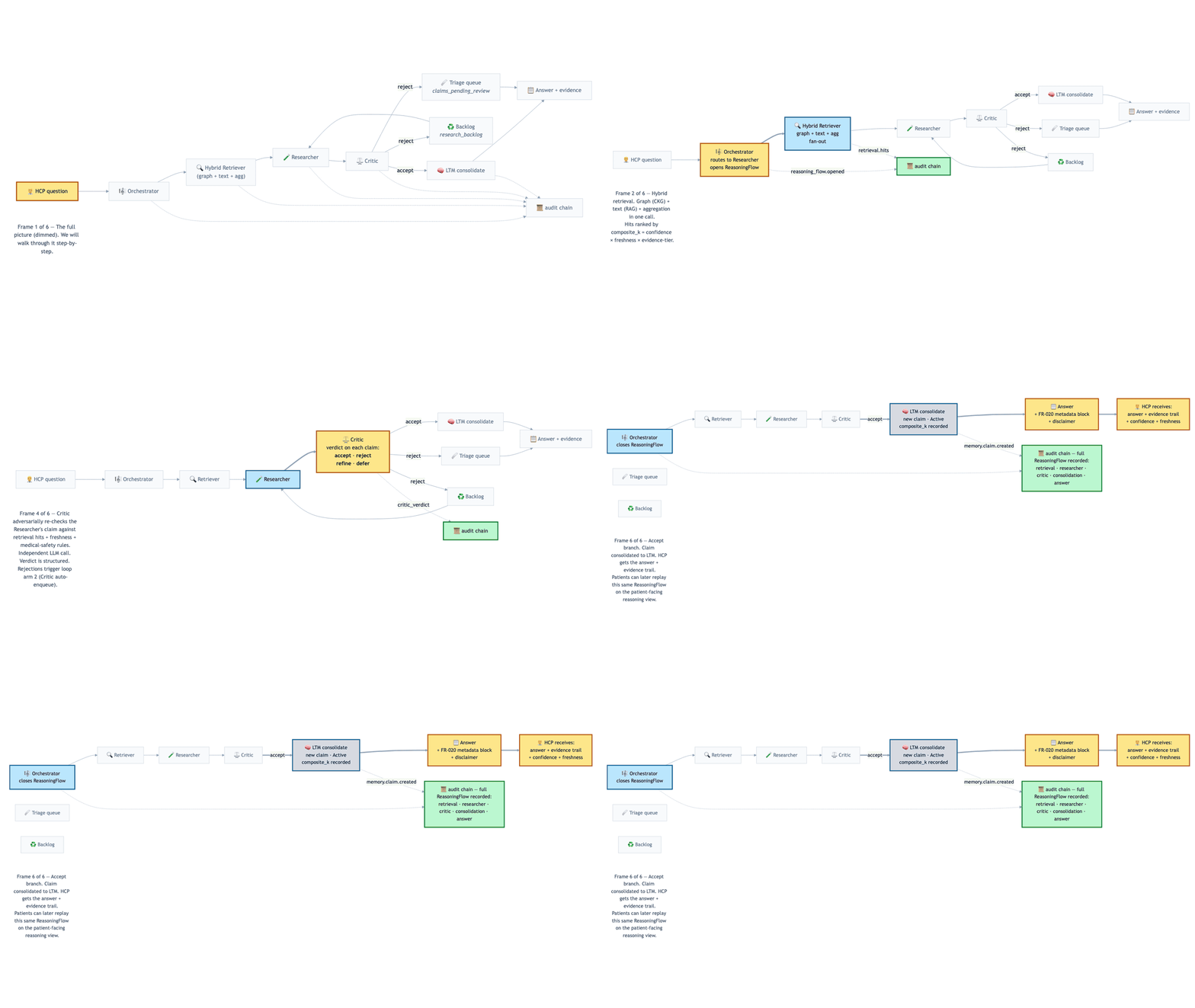
The full picture starts dimmed. Each step lights up the agent that is currently active.
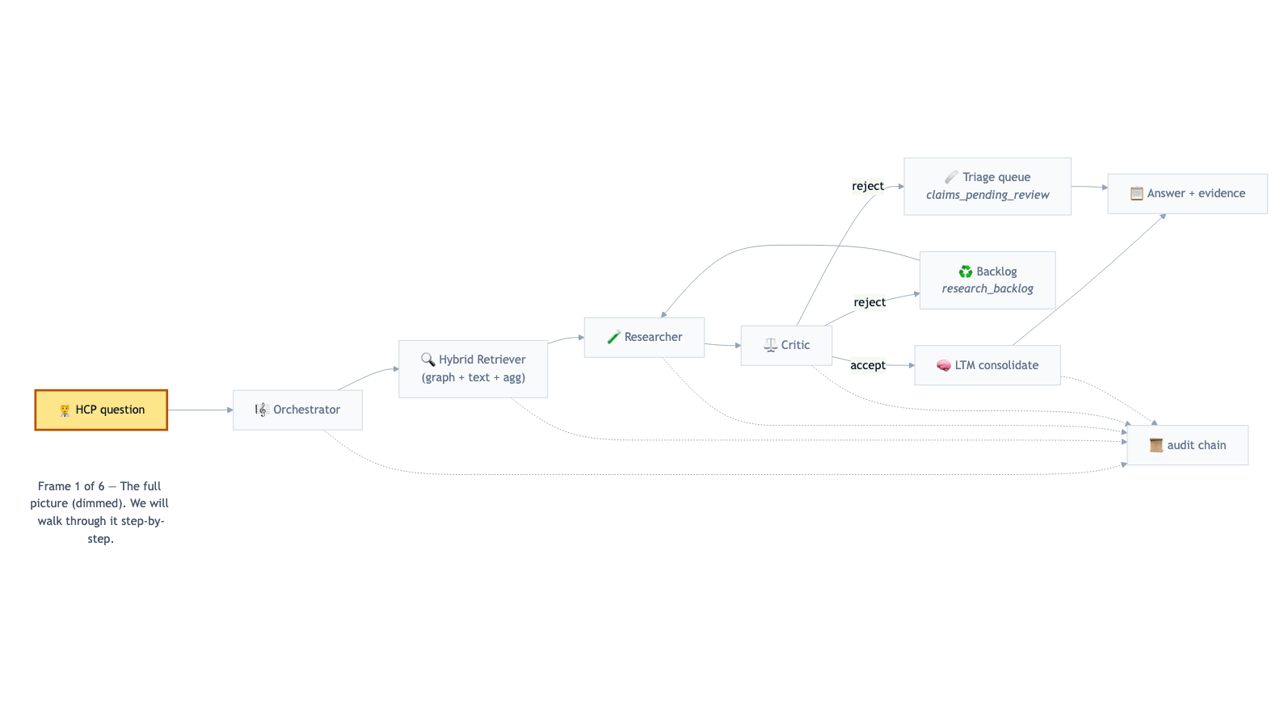
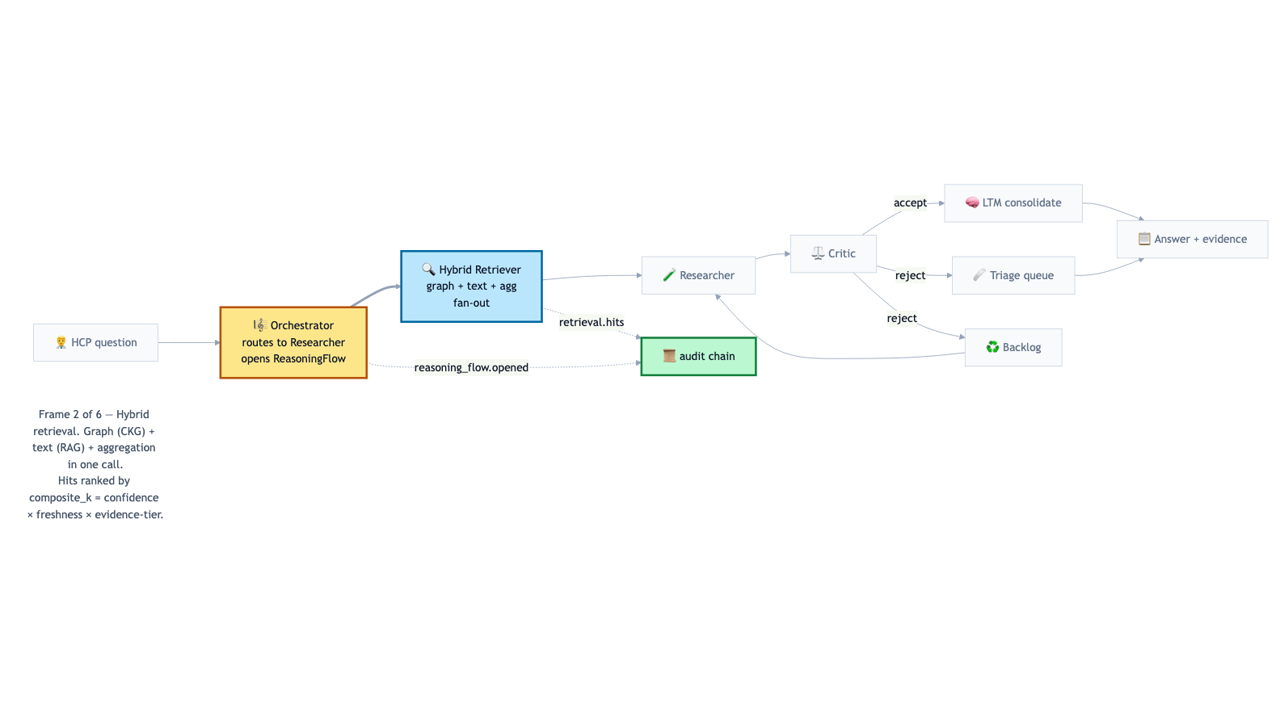
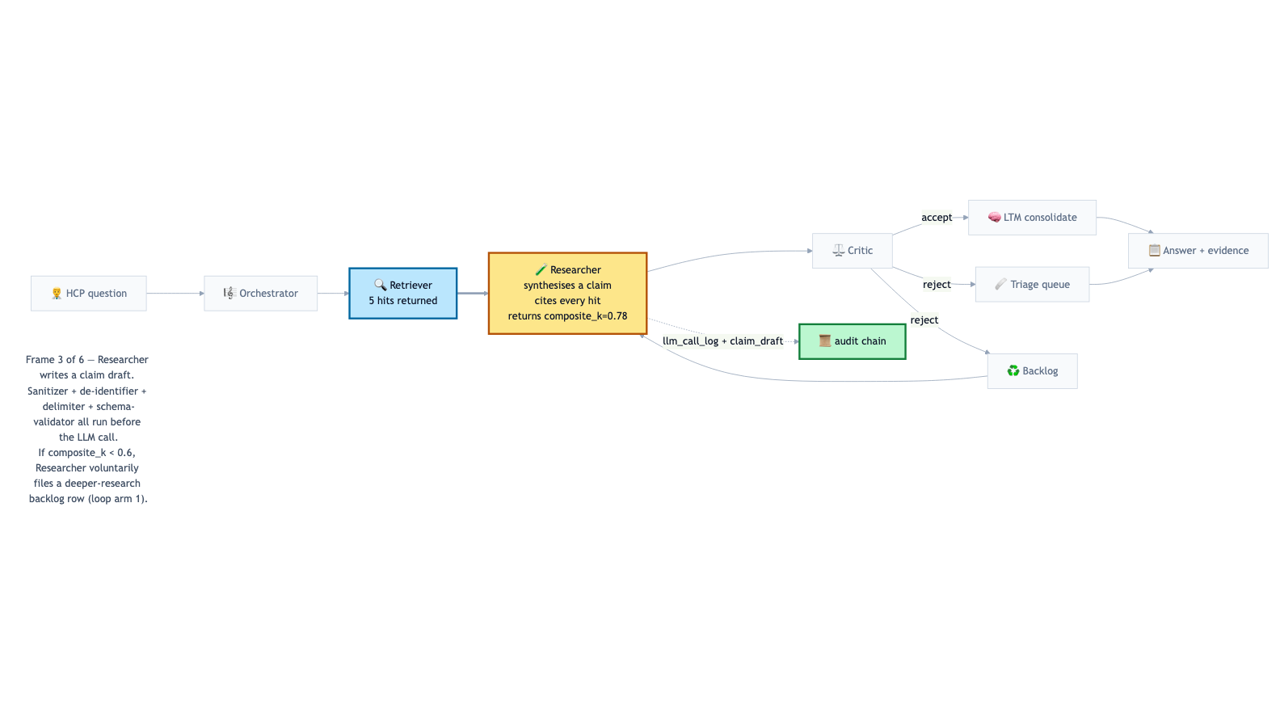
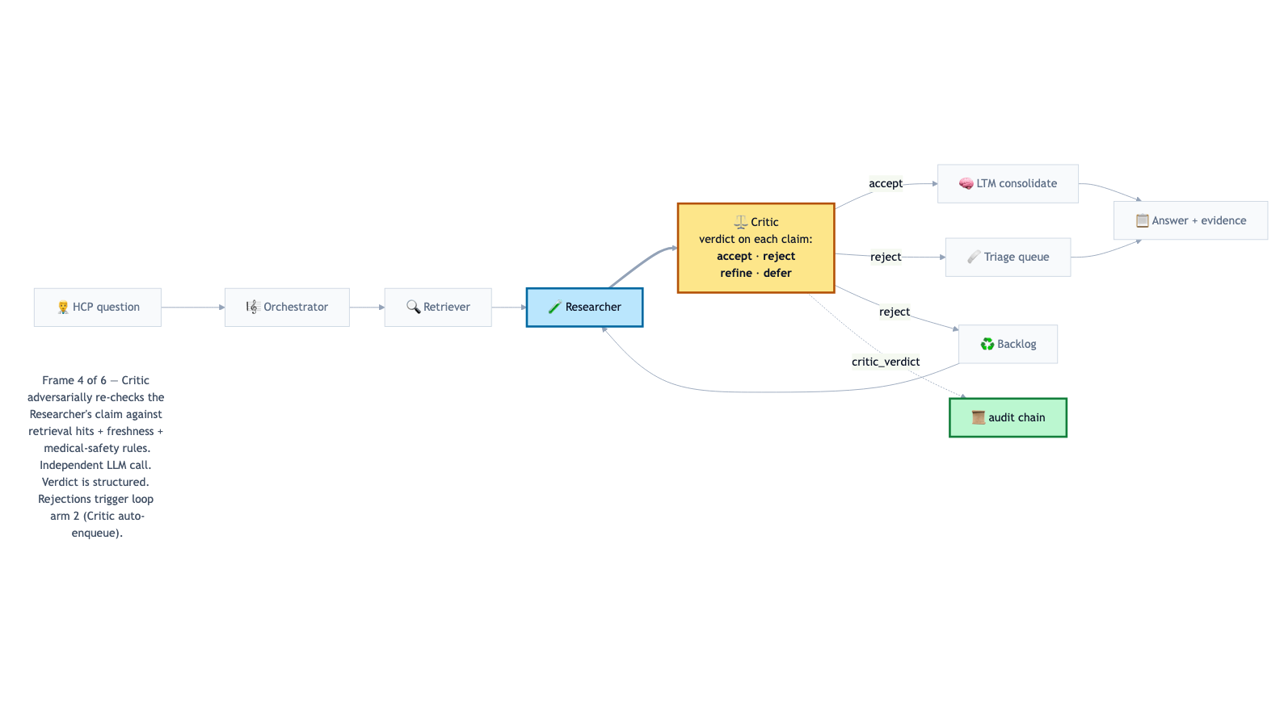
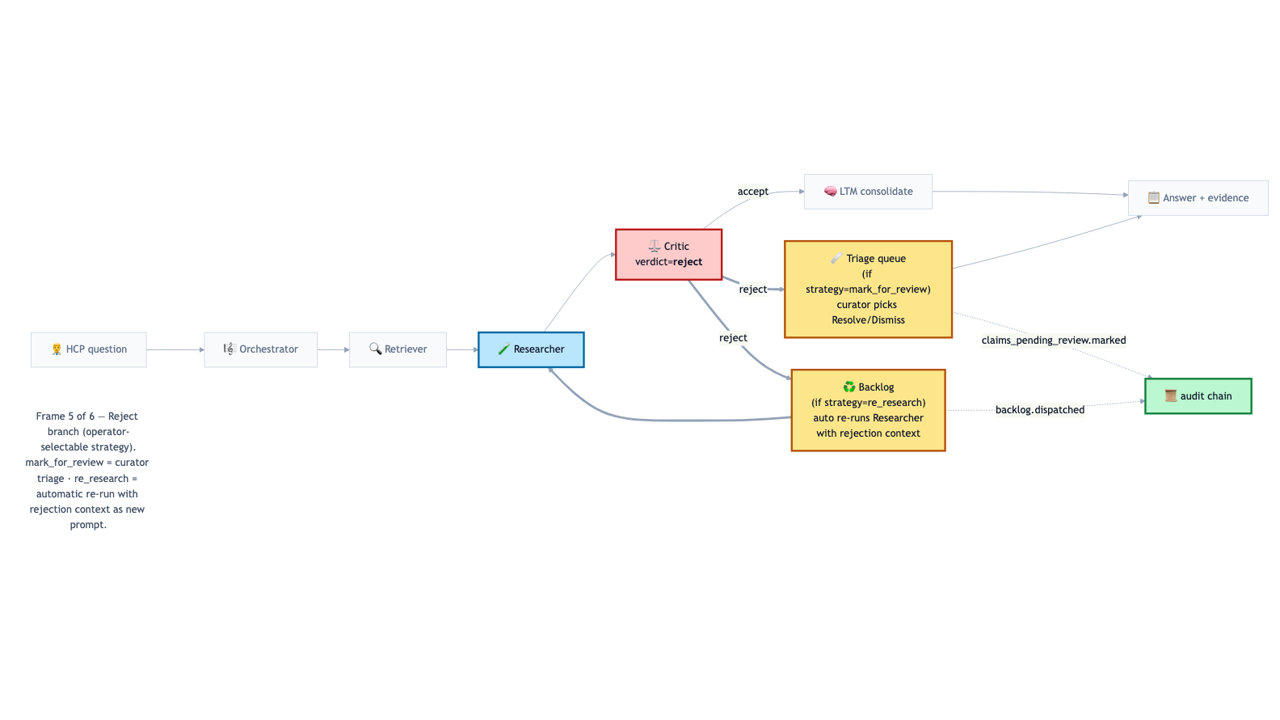
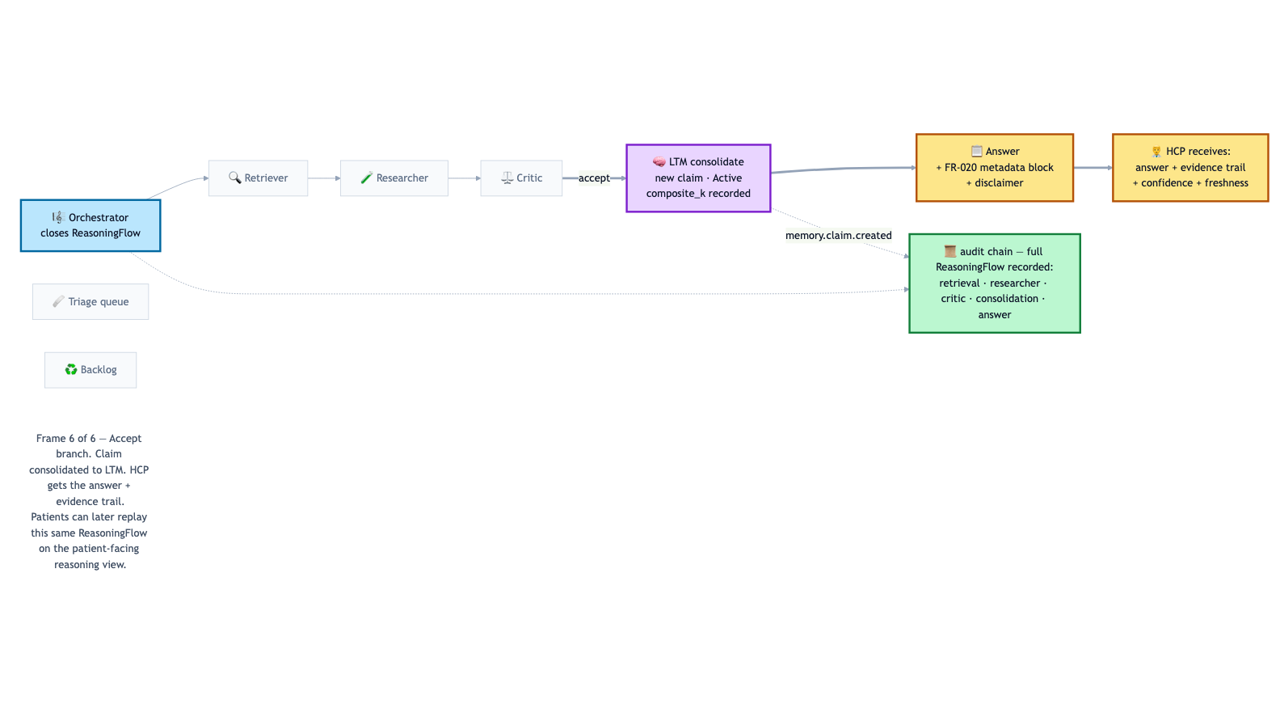
Frame 1 of 6 — The full picture (dimmed). Roadmap for the walkthrough; we light up one agent per step.
Prefer an auto-looping GIF? Download the animated GIF. Use the buttons above (or ←/→/Space) to scrub frame-by-frame at your own pace.
The full ReasoningFlow — every retrieval, prompt, classification, supersession, freshness check, verdict — is recorded. Patients can later replay it on the patient-facing reasoning view.
Decision point 1 — Retrieval mode
The hybrid retriever can be steered toward graph-only, text-only, or balanced hybrid. Default is hybrid; specialty workflows occasionally override.
| Mode | Pros | Cons | When to choose |
|---|---|---|---|
| Graph-only (CKG) | Precise relationships ("first-line for X" / "contraindicated with Y"); easy to cite the source guideline; fast | Misses claims not yet in the curated graph; brittle to entity-resolution misses; weak on free-text patient narratives | Drug–drug, drug–condition, guideline-driven queries with a clean entity set |
| Text-only (RAG over journals) | Highest recall on novel evidence (NEJM, JAMA, Cochrane); fluent narrative answers | Can hallucinate without a graph anchor; freshness depends on the embedding refresh job; harder to cite cleanly | Open-ended literature surveys; "what's new in X" queries |
| Hybrid (graph + text + agg) — default | Graph anchor keeps citations clean; text fills the recall gap; aggregation queries enable population-level prompts | Higher latency (parallel fan-out + late merge); ranking the merged set is more complex (the composite_k score does this) | Default. Most clinical questions sit between the two extremes |
Implementation pointer: the dispatcher lives at apps/research/memory-store/services/retrieval/hybrid_retriever.py; per-mode classifiers in classifier.py route the call. Spec 060 (Hybrid Retrieval Core).
Decision point 2 — Critic dispatch strategy
When the Critic rejects a claim, the consumer can route the rejection one of two ways. The strategies are mutually exclusive at runtime, selected via CRITIC_DISPATCH_STRATEGY.
| Strategy | Pros | Cons | When to choose |
|---|---|---|---|
mark_for_review (default) | Human-in-the-loop. Curator catches subtle semantic errors that re-research can't fix. Lower LLM spend per rejection. | Curator workload scales with rejection volume; queue can grow if staffing is thin. Pending-review entries have to be drained manually. | Critic rejections are mostly semantic — the claim is wrong, not just under-supported. Re-research would reproduce the defect. |
re_research | Fully automated. The dispatcher synthesises a research-task input that includes the rejection reason, then re-runs the Researcher with the loop-break marker dispatched_from_backlog=True. No curator round-trip. | Burns LLM tokens on every reject. If the original retrieval set was the bottleneck, re-research will just produce another weak claim (the loop voluntary-fails with still_weak_after_critic_reject:k=...). | Critic rejections are evidence-quality — low support, low novelty, weak composite_k. Fresh research with rejection context yields stronger evidence. |
Switching between them is reversible — see research/loop-activation. Existing pending-review entries from a prior mark_for_review run stay in the triage queue (not auto-converted).
Decision point 3 — Source tier mix
Retrieval ranks across multiple source tiers. Operators tune the weight given to each tier (config: apps/research/research-engine/services/config/trusted_sources.yml).
| Source tier | Pros | Cons | Weight in default composite_k |
|---|---|---|---|
| NCCN guidelines | Authoritative; clinically actionable; revised on a known cadence | Slow to incorporate brand-new evidence; US-centric | High (1.0) |
| NEJM / JAMA / JBJS (publisher AI partners) | Peer-reviewed; high signal per article; citations are clean | License-gated; embedding refresh latency; breadth limited to subscribed journals | High (0.95) |
| Cochrane (systematic reviews) | Strongest summary of effect sizes; ideal for "does X work" | Updates infrequently; narrow topic coverage | High (0.95) |
| JOR / JBMR-B / Spine / Acta / J. Arthroplasty (specialty journals) | Deep coverage of orthopaedic / specialty subdomain | Narrower than NEJM; smaller audience | Med (0.8) |
| PubMed (broad) | Highest recall; freshest preprints | Mixed quality — needs Critic re-check; some predatory sources | Med (0.6) |
| ClinicalTrials.gov | Authoritative for what trials exist; no PHI outbound | Doesn't tell you outcomes — only protocols and status; needs joining to NEJM/JAMA results | Med (0.7) — boosted for "is there a trial for X" queries |
| ClinVar (variants) | Authoritative for genetic variant interpretation; public NIH | Niche; only relevant when query touches genetics | High (0.95) when query is on-topic; otherwise weight=0 |
| DrugBank | Comprehensive drug–drug + drug–target catalog | Commercial license (no PHI outbound); doesn't carry guideline strength | High (0.9) for pharmacology queries |
Rule of thumb: a strong claim cites at least one NCCN/NEJM/JAMA/Cochrane anchor plus one corroborating source from a different tier. The Critic flags single-tier claims as low_support even when composite_k would otherwise pass — that's intentional defense in depth.
Where the safety rails live
The pipeline is bracketed by hard rules (these never turn off in production):
- PHI in / PHI out —
apps/ml/services/sanitize.py(G-01..G-20 prompt-injection patterns) +deidentify.pyrun on every prompt. The<<<CLINICAL_DATA>>>delimiter scopes user content as data, not instruction. Output passes Pydantic schema validation before reaching the HCP. - BAA registry — every LLM provider, journal source, and embedding service must be entered in
apps/api/src/config/baa-registry.yml. Production fails-closed if any vendor hasbaa_signed: false(FR-032). - Audit chain — the
ReasoningFlowrecords the what with opaque IDs only;llm_call_logsholds the encrypted prompt + output content, joined back bytrace_id. Auditors have everything; logs and audit payloads have no PHI narrative. - FDA / Cures-Act exemption posture — every AI response carries the FR-020 metadata block:
{ disclaimer, llm_call_id, model_provider, model_name, generated_at, fda_cds_exemption_ref }. The HCP confirms; the system never auto-acts.
Where this is implemented
| Stage | Code | Spec |
|---|---|---|
| Orchestrator | apps/research/research-engine/services/orchestrator/ | 050 |
| Hybrid Retriever | apps/research/memory-store/services/retrieval/ | 060 |
| Researcher | apps/research/research-engine/services/agents/researcher/ | 050 |
| Critic | apps/research/research-engine/services/agents/critic/ | 050 |
| Backlog + consumer + triage queue | apps/research/research-engine/services/workers/ + memory-store routes | 066 |
| Reasoning flow recorder | apps/research/research-engine/services/recorders/ | 066 |
| Source-tier weighting | apps/research/research-engine/services/config/trusted_sources.yml | 056, 059 |
Related pages
- Memory Concepts → — three-tier model + how data moves.
- Reasoning Flow → —
ReasoningFlow/ReasoningStepschema + the self-improvement loop. - Self-Improvement Loop — Activation Runbook → — operator-facing flag-flip order, including the Critic-strategy switch.
- Hybrid Retrieval → — retriever internals.
- Agents → — Researcher / Critic / other agent details.