Memory Concepts — Interactive Walkthrough
AiMOneHealth's clinical reasoning sits on top of a three-tier memory model: Episodic, Short-Term, and Long-Term. Functional teams need to know what each tier does; technical teams need to know how data moves between them. This page covers both with two interactive walkthroughs — click Next to advance one step at a time, or hit Play for slower autoplay.
Controls — ◀ / ▶ buttons step manually · ▶ Play autoplays (default 3.5s/frame; pick from the Speed menu, slowest is 6s) · click any dot to jump · keyboard
←/→/Spacewhen the panel has focus.
For the formal specification (collections, schemas, retention windows, the 19-flow legal-transition matrix), see memory-hierarchy. For the agent-loop view, see reasoning-flow.
Walkthrough 1 — How a single patient question touches all three tiers
Dr. Vance asks her assistant: "What is the latest evidence for this patient's chemo regimen?" Step through to see how that single ask ripples across the memory model.
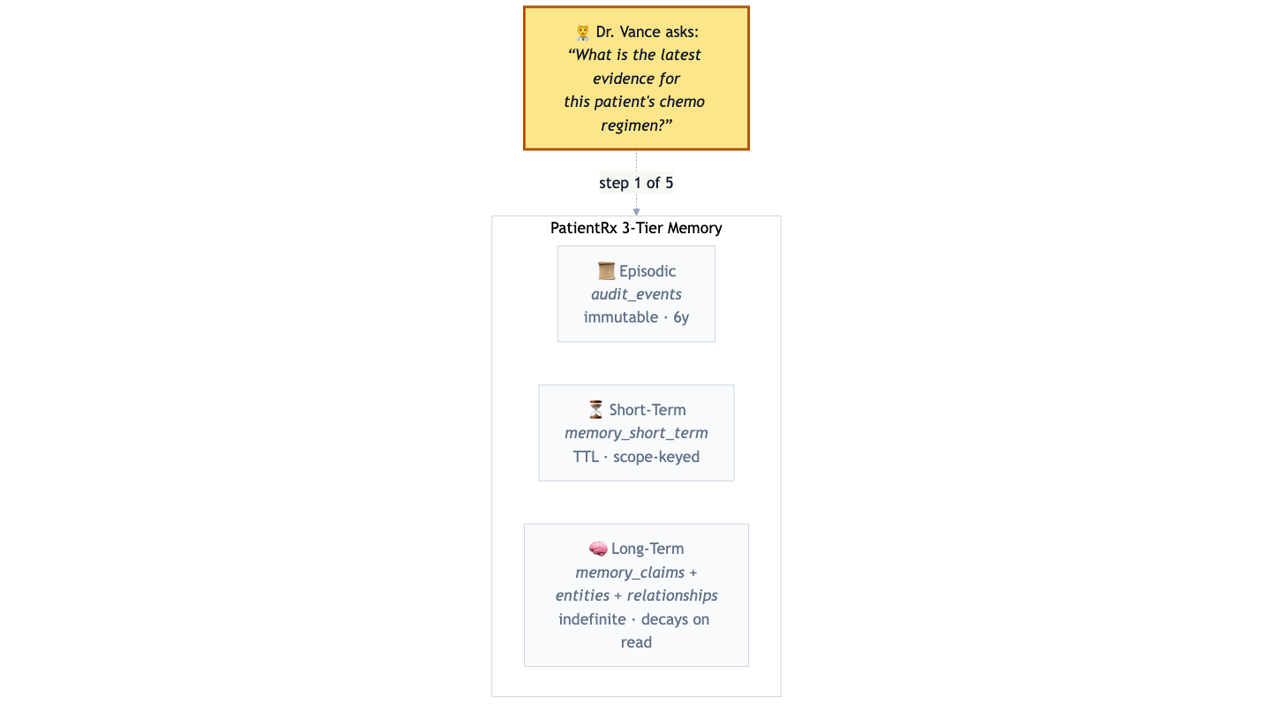
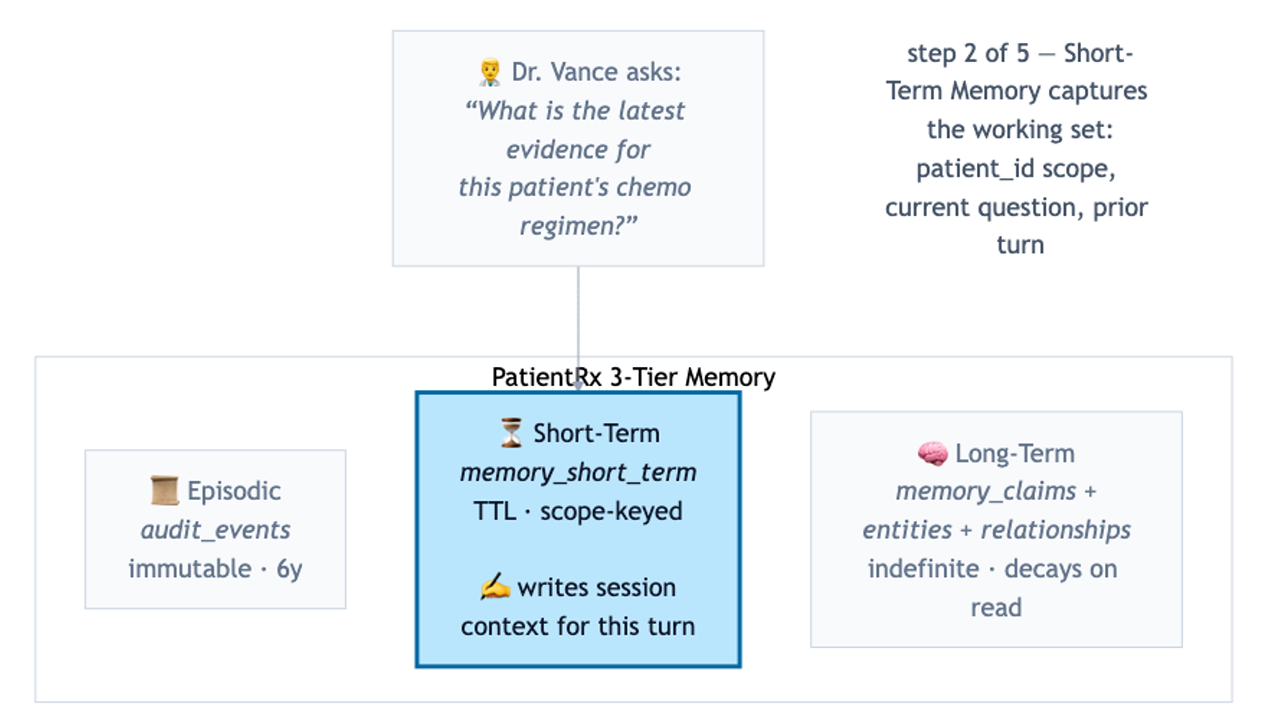
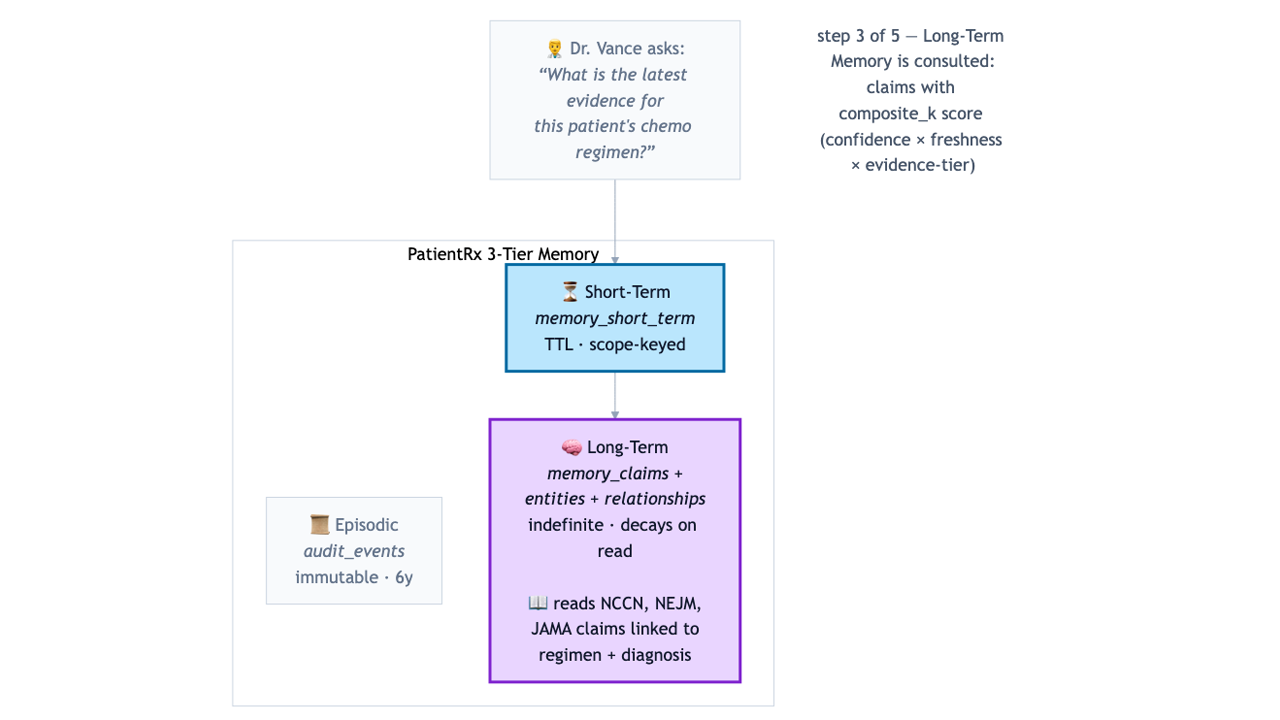
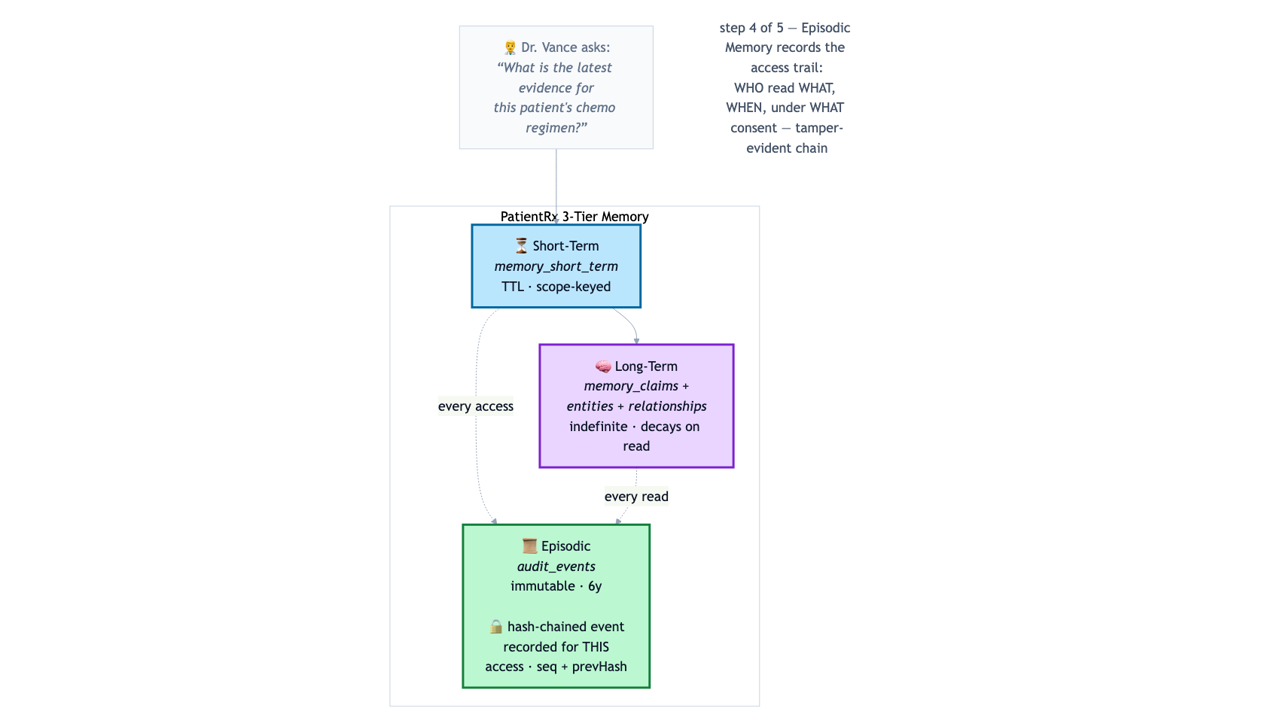
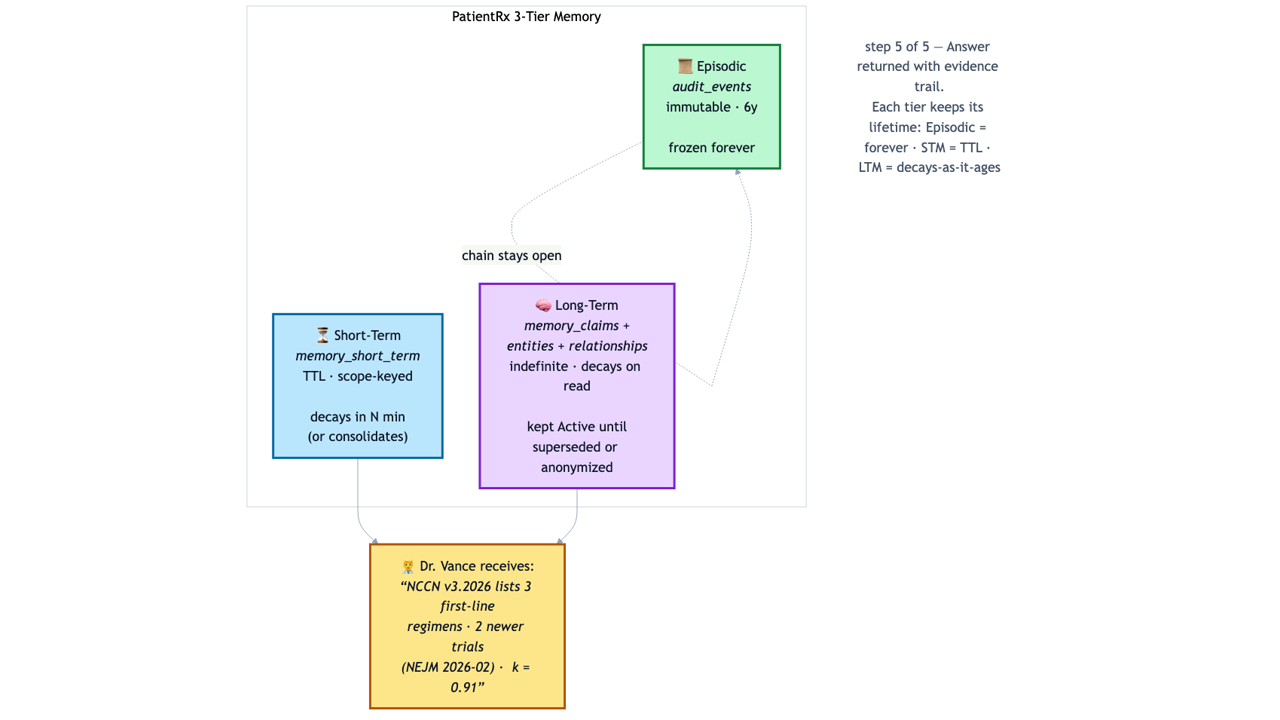
Step 1 of 5 — The question lands at the agent. No memory tier has been touched yet.
Prefer an auto-looping GIF? Download the animated GIF. Use the buttons above (or ←/→/Space) to scrub frame-by-frame at your own pace.
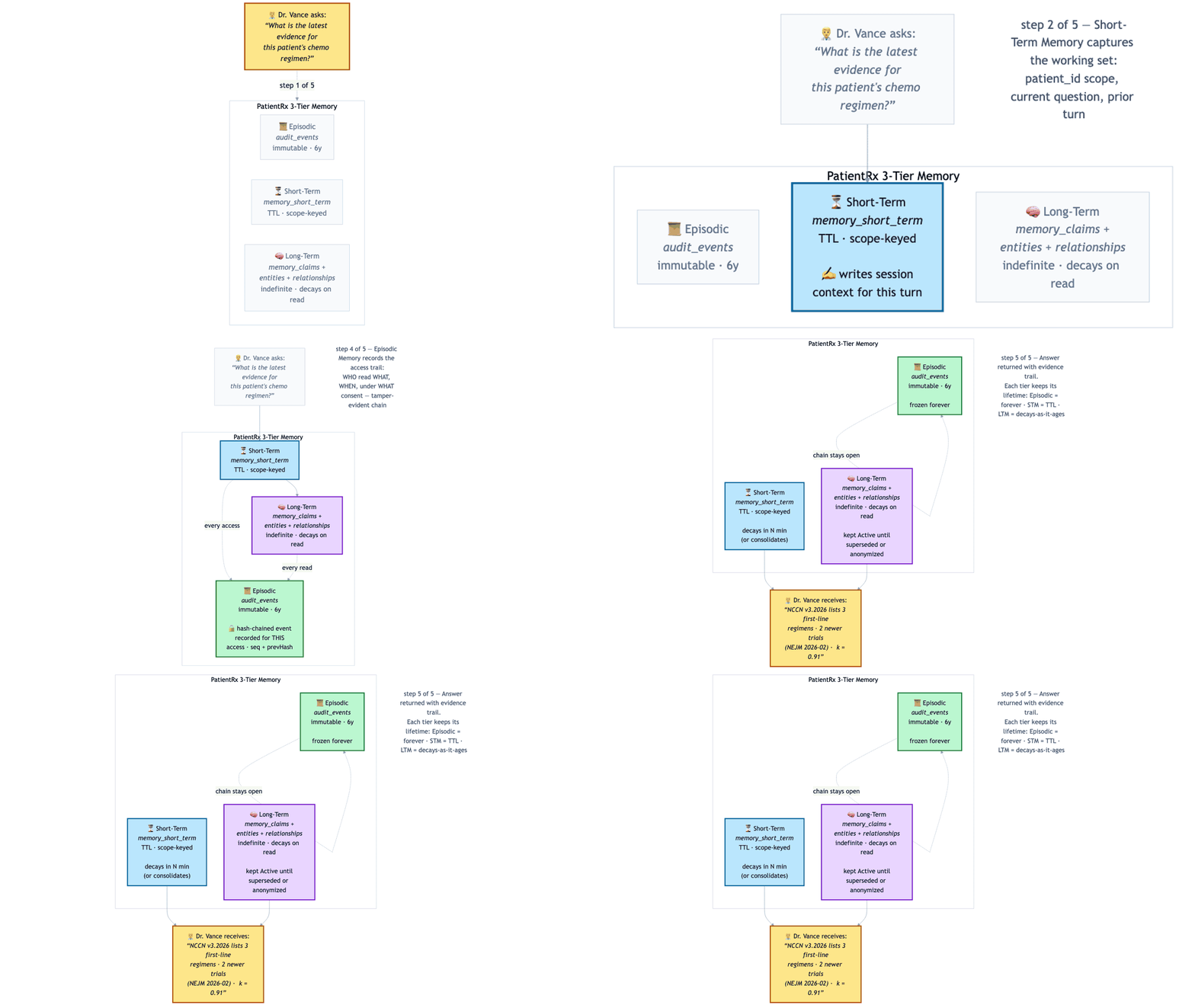
Plain-English summary (functional team)
- Short-Term = the agent's working memory for this conversation. Forgotten on TTL.
- Long-Term = what the system has learned — clinical claims with sources and confidence. Kept indefinitely while still relevant.
- Episodic = the paper trail of every access. Auditors replay history from this; nothing else can.
Schema hooks (technical team)
| Tier | Backing collection | PHI handling | Lifetime |
|---|---|---|---|
| Episodic | audit_events | seq + prevHash + eventHash (RFC 8785 JCS + SHA-256); patient/user IDs only — never narrative | 6 years (HIPAA floor) |
| Short-Term | memory_short_term | @phi_repository envelope encryption; pii_fields per row; patient_id scope required | TTL via Mongo TTL index on expires_at |
| Long-Term | memory_claims, memory_entities, memory_relationships | Envelope-encrypted at the repository boundary; supersession on update; decay_at anonymization in place | Indefinite while Active |
Walkthrough 2 — How data moves between the tiers
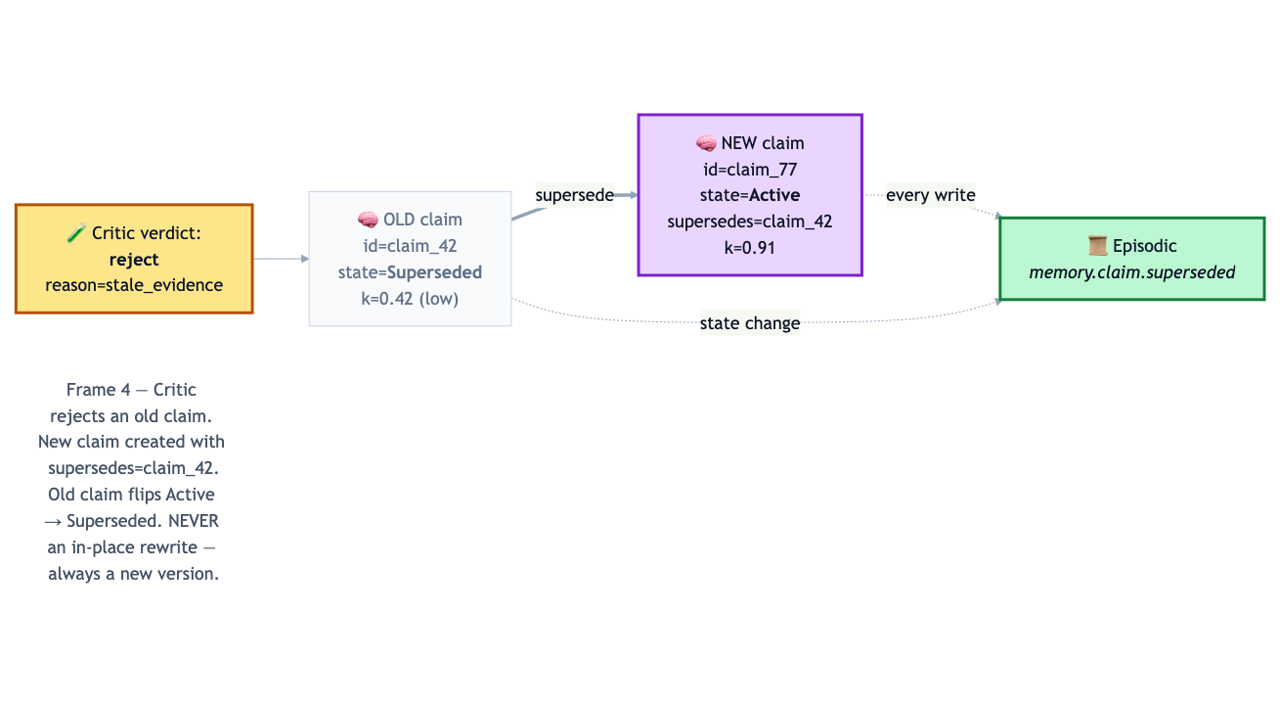
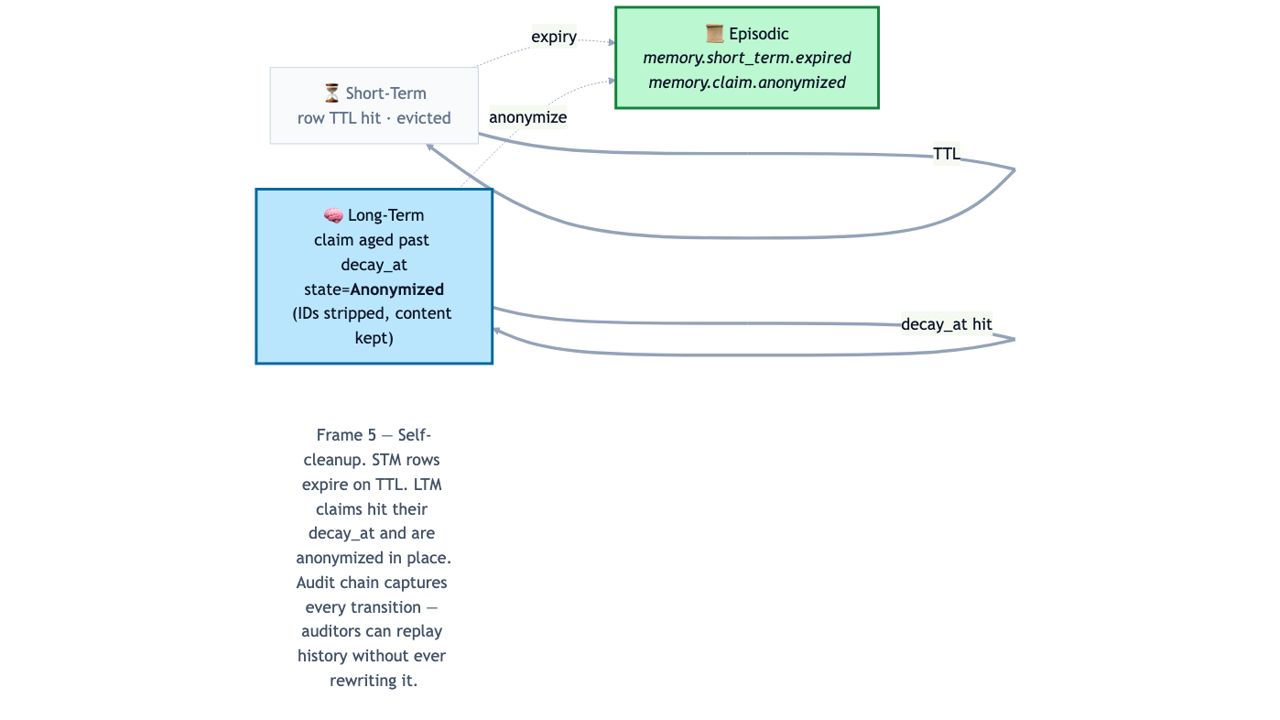
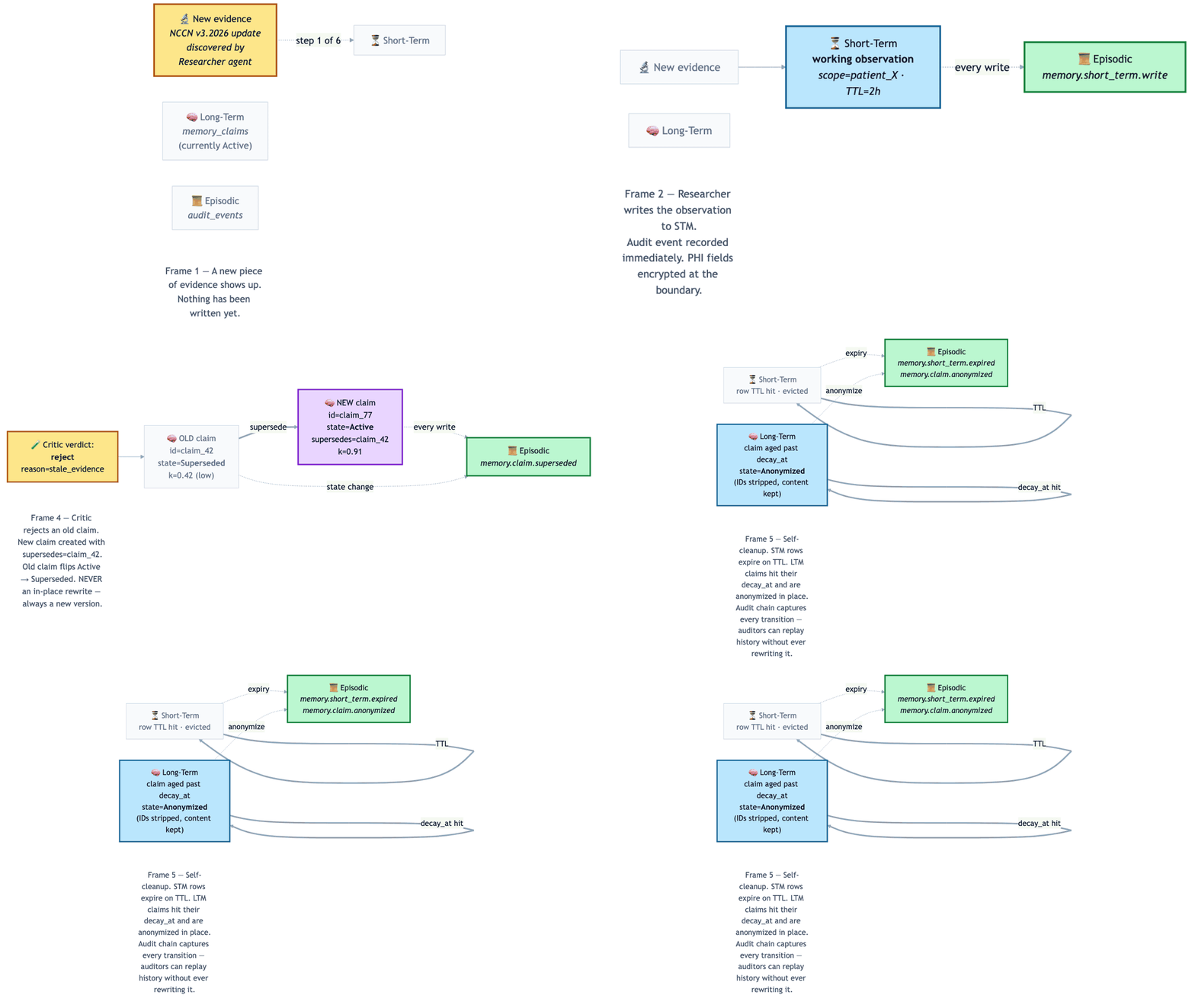
The interesting part isn't the tiers themselves — it's the legal transitions. Five steps cover the four movements you'll see in production: write, consolidate, supersede, decay.
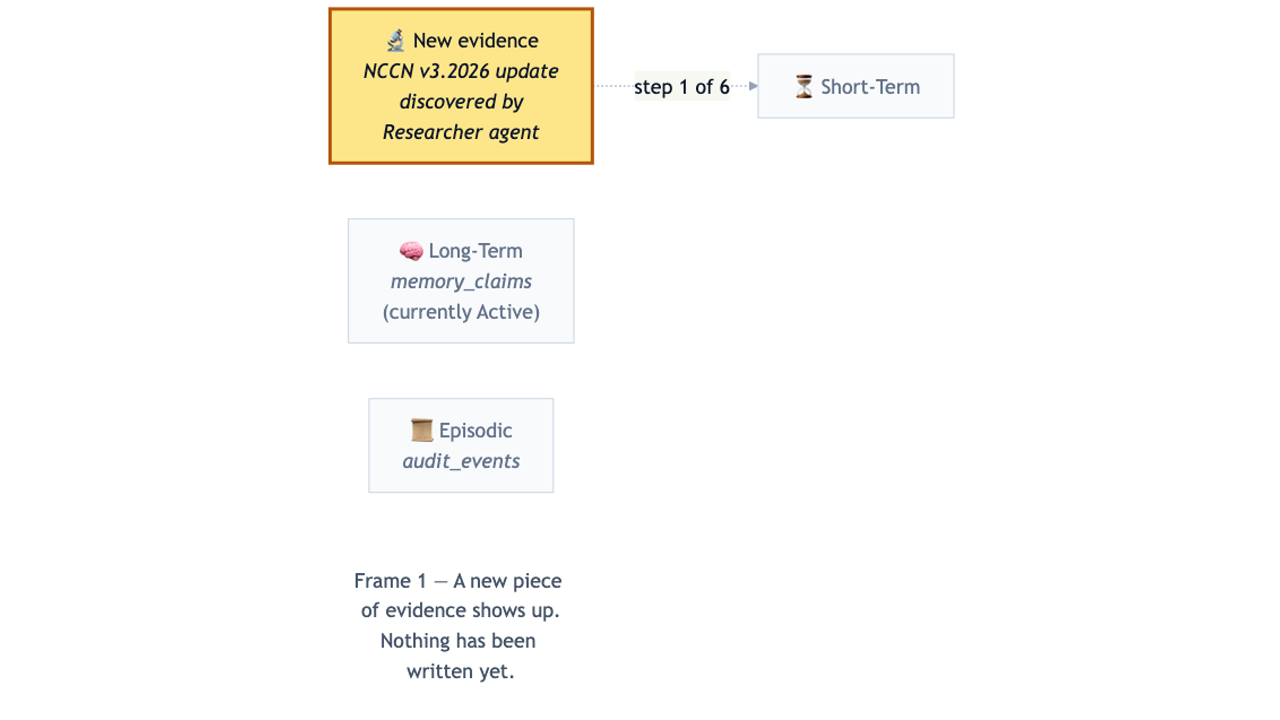
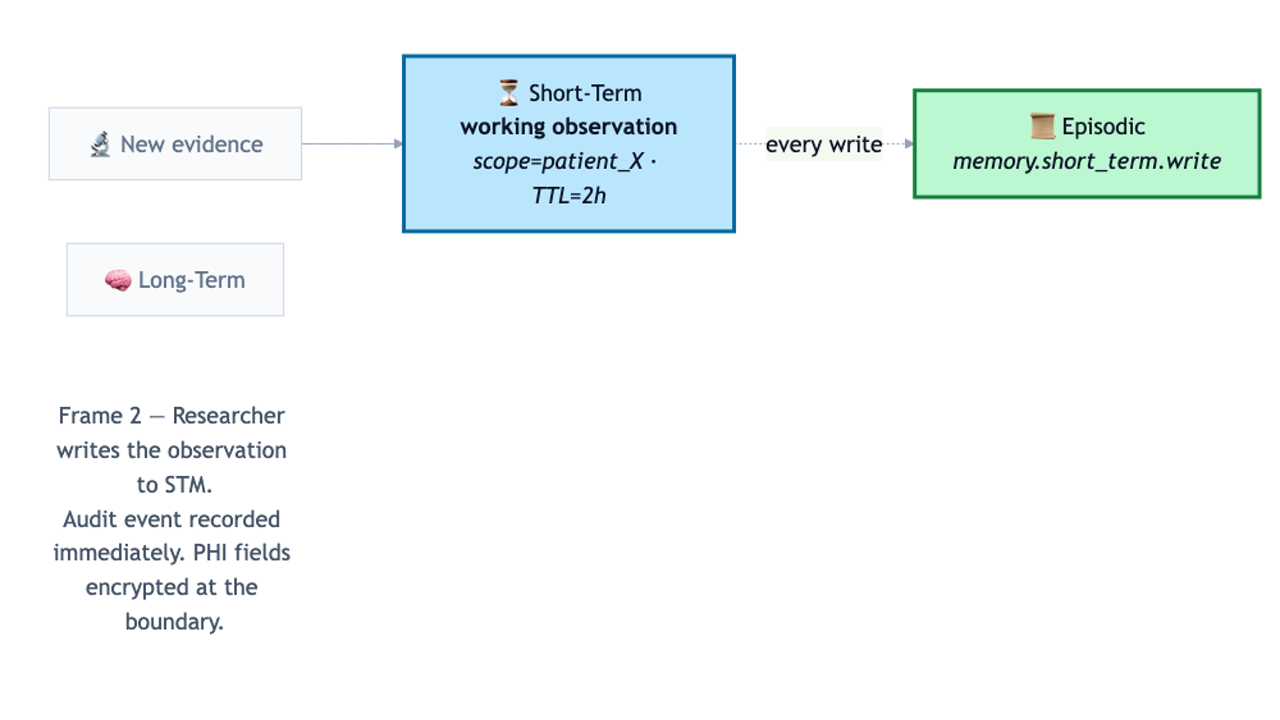
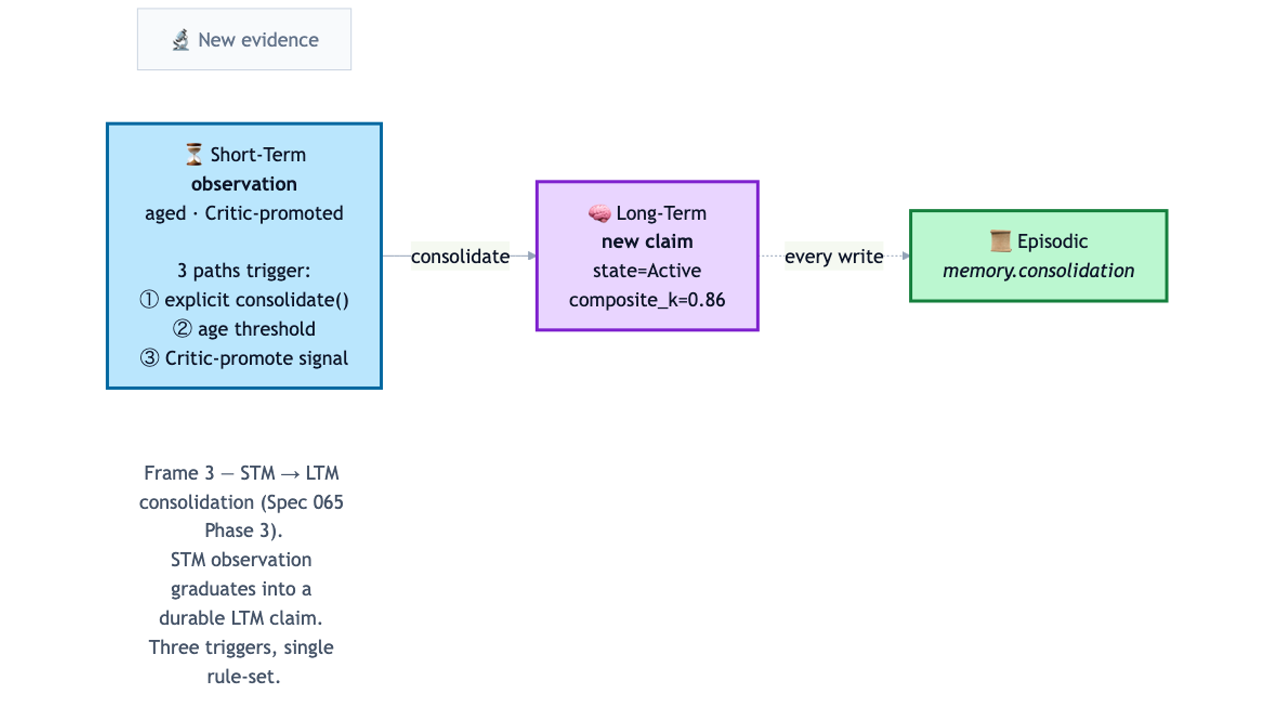
Frame 1 of 5 — A new piece of evidence shows up (e.g., Researcher discovers an NCCN update). Nothing has been written yet.
Prefer an auto-looping GIF? Download the animated GIF. Use the buttons above (or ←/→/Space) to scrub frame-by-frame at your own pace.
Why this design? (balanced view)
| Property | Benefit | Trade-off |
|---|---|---|
| Three tiers, separate stores | Lifetimes can differ — Episodic forever, STM minutes, LTM indefinite-but-decaying — without one tier's policy bleeding into another | More moving pieces; consolidation paths must be explicitly designed (and they are: 19-flow matrix in memory-hierarchy) |
| Append-only Episodic with hash chain | Tamper-evident; auditors replay rather than trust | Storage grows monotonically; offsets via the 6-year retention window |
| Supersession instead of in-place edits | Every fact has a version history; no fact is silently rewritten | Reads must filter state=Active; supersession chains add one indirection |
Anonymization-in-place at decay_at | LTM keeps the content (e.g., "metformin first-line for T2D") even after the patient/source identifiers are stripped, so the system gets smarter over time | Anonymization rule must be conservative — over-anonymize and the claim becomes useless |
Illegal transitions (fail-closed)
These will refuse to execute:
- ❌ Source → Episodic bypassing the originating tier (every episodic event names a source tier).
- ❌ STM → STM cross-scope (admin-only override).
- ❌ LTM → LTM in-place content rewrite — corrections route through
supersede, never PATCH. - ❌ Episodic → any writable tier — replay produces derived data, never mutates the chain.
Where this is implemented
- Spec 08 — Episodic + LTM original specification.
- Spec 065 — STM tier + consolidation pipeline.
- Spec 063 — Freshness + confidence scoring (drives
composite_k). - Spec 064 — Numeric freshness scorer (drives
decay_at). - Spec 066 — Self-improvement loop that ties Critic verdicts back to LTM supersession.
Related pages
- Memory Hierarchy → — full schema, retention table, 19-flow legal-transition matrix.
- Reasoning Flow → — how agents emit
ReasoningFlow+ReasoningSteprecords that link back to claim IDs. - Specialist Research Process → — end-to-end walkthrough showing how a question flows through retrieval → researcher → critic → memory.